
Vertigo & Balance Centre
Comprehensive Care for Vertigo, Dizziness and Balance Disorders
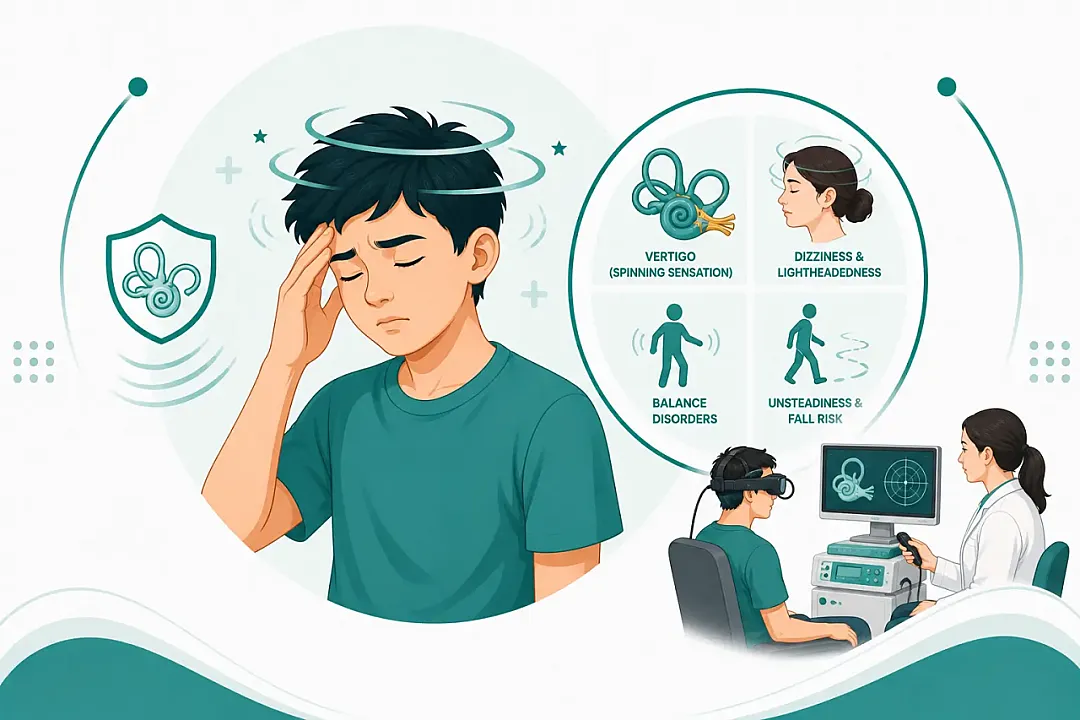
About the Treatment
Understanding Vertigo & Balance Centre
Feeling as though the room is spinning, experiencing frequent dizziness, or struggling to maintain your balance can affect your confidence, mobility, and daily activities. While occasional dizziness may not always be serious, persistent or recurring symptoms should be evaluated to identify the underlying cause.
At Dr Hans' Centre for ENT, we provide comprehensive diagnosis and treatment for vertigo and balance disorders in children and adults. Our ENT specialists use advanced diagnostic methods to determine the cause of dizziness and develop personalized treatment plans to help patients regain balance and improve their quality of life.
What We Offer
Our Vertigo & Balance Centre Services
Vertigo is more than just feeling dizzy. It is the sensation that you or your surroundings are moving or spinning when there is no actual movement. Since vertigo can result from inner ear disorders, neurological conditions, or other medical causes, a detailed evaluation is essential. Balance problems can make walking, standing, or performing everyday activities difficult.
Our specialists perform a thorough clinical assessment, review your medical history, and recommend appropriate diagnostic tests to identify the underlying cause and guide treatment.
Videonystagmography (VNG) is a comprehensive vestibular function test that uses infrared video goggles to record eye movements and differentiate peripheral from central causes of vertigo.
Tests performed:
- Oculomotor tests (saccades, smooth pursuit, optokinetic test)
- Positional and positioning tests (including Dix-Hallpike) for BPPV
- Spontaneous and gaze-evoked nystagmus
- Caloric testing
Clinical applications: diagnosis of vestibular neuritis, Ménière's disease, BPPV, bilateral vestibular hypofunction, and central vestibular disorders.
For patients with imbalance, Dynamic Visual Acuity (DVA) assesses the functional integrity of the vestibulo-ocular reflex by measuring visual acuity during head movement.
Clinical significance: detects vestibular hypofunction and is useful for assessment before and after vestibular rehabilitation.
Subjective Visual Vertical (SVV) evaluates otolith (primarily utricular) function by assessing the patient's perception of true vertical orientation. Useful in disorders such as vestibular neuritis, Ménière's disease, vestibular migraine, and brainstem or cerebellar lesions.
This is a painless, non-invasive balance test that evaluates how well your body maintains stability while standing under different conditions. It measures how your eyes, inner ears (balance organs), and muscles and joints work together to keep you balanced. During the test, you stand on a special platform while following simple instructions. The results help identify the cause of balance problems, dizziness, or frequent falls, and assist doctors in planning the most effective treatment and balance rehabilitation exercises.
Vestibular rehabilitation is a specialized exercise-based therapy designed to help the brain adapt to balance disorders caused by inner ear conditions. It focuses on improving stability, reducing dizziness, enhancing coordination, and restoring confidence during daily activities. Our rehabilitation programme is individualized according to the patient's diagnosis, symptoms, and recovery goals.
Cognitive Behavioral Therapy (CBT) is a structured psychological treatment that helps patients manage the fear, anxiety, and avoidance behaviors often associated with chronic dizziness and vertigo. It teaches patients to identify and modify unhelpful thoughts, gradually resume normal activities, and develop coping strategies to reduce dizziness-related distress. CBT does not treat the underlying vestibular disorder itself but complements medical treatment and vestibular rehabilitation, improving confidence, quality of life, and functional recovery, particularly in conditions such as persistent postural-perceptual dizziness (PPPD), vestibular migraine, and chronic dizziness.
Common Questions
Frequently Asked Questions
Dizziness is a general feeling of light-headedness or unsteadiness, while vertigo is the sensation that you or your surroundings are spinning or moving.
You should consult an ENT specialist if vertigo is severe, recurrent, lasts for several minutes or longer, or is associated with hearing loss, persistent imbalance, or frequent falls.
Benign Paroxysmal Positional Vertigo (BPPV) is a common inner ear condition that causes brief episodes of vertigo triggered by certain head movements or change in position.
Yes. Most cases of vertigo are managed with repositioning manoeuvres. Surgery is required only in selected rare cases.
Balance disorders may result from inner ear conditions, infections, ageing, neurological disorders, head injuries, or certain medications.
Vestibular rehabilitation is a specialized therapy programme that uses targeted exercises to improve balance, reduce dizziness, and help patients adapt to inner ear disorders.
Yes. Although less common than in adults, children can experience vertigo and balance disorders that require specialist evaluation.
Diagnosis involves a detailed medical history, physical examination, balance assessment, hearing evaluation when required, and other investigations based on the patient's symptoms.
Take the First Step Towards Better Health
Our team is here to guide you with compassion and expertise.